
One in Five Job Ads Leads Nowhere. Here’s How to Score Yours.

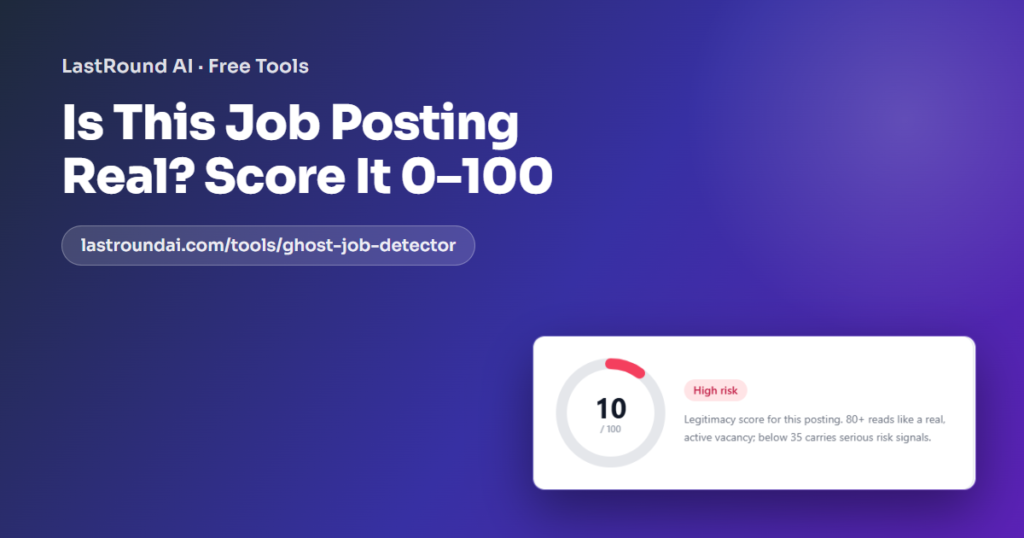
Last week we pasted a WhatsApp job forward into the ghost job detector we’d just shipped: work-from-home data entry, ₹25,000 to ₹40,000 a month, no interview needed, a ₹2,500 “registration fee” payable by UPI. It scored 10 out of 100. Then we pasted a real senior backend posting with a named team, a stated salary band, and a four-stage process. It scored 90. The interesting part isn’t that the tool can tell them apart. It’s how much measurable signal sits in posting text that most of us skim in nine seconds.
The scale of the problem is better documented than people assume. Greenhouse’s own platform review found 18-22% of postings in a given quarter were ghost jobs, and roughly 70% of companies had posted at least one. Separately, research from Baruch College puts the ceiling near 21% and argues ghost postings help explain why vacancies look plentiful while hiring feels frozen. Whether the true number is 18% or 22% is uncertain. Either way, roughly one in five applications goes into a req nobody intends to fill soon.
What is a ghost job?
A ghost job is a posting a company keeps live without an active intent to hire against it right now. Companies post them to stockpile resumes, look like they’re growing, satisfy policy before an internal promotion, or simply because nobody removed a stale listing. The employer is usually real; the vacancy, at that moment, is not.
That last distinction matters, because a ghost job wastes your time while a scam takes your money. They need different responses, and mixing them up leads people to either paranoia or complacency.
Five kinds of postings that go nowhere
In building the detector’s rubric we ended up with a taxonomy. Real company, frozen req (the classic ghost). Evergreen talent-pool listings (“always accepting applications”), which are honest but low-yield. Stale reposts that were filled months ago. Staffing-agency bait, posted to build a bench rather than fill a role. And outright fraud, which is its own category with its own stakes.
The first four cost you hours. The fifth costs real money: the FTC logged $501 million in reported job-scam losses in 2024, up from $90 million in 2020, and the India-specific variants (fake offer letters from big IT brands, UPI “registration fees”) are common enough to have their own government reporting channel.
Signals you can check in about 60 seconds
Posting age is the strongest single tell. Median time-to-fill is around 39 days, so a listing that’s been up (or reposted) for 3 months is either filled or was never funded. Check whether the role exists on the company’s own careers page; a posting that lives only on aggregators is usually stale or scraped. Missing salary in a place that mandates disclosure is a flag. So is a “junior” title demanding 8+ years, and a description with no named team, product, or manager.
For scams the list is shorter and harder: any fee at any stage, any request for Aadhaar, PAN, or bank details before an offer, recruiters on WhatsApp or Telegram, free-email contact addresses, interviews conducted entirely over chat. A famous company name plus a Gmail contact isn’t a famous company. It’s someone wearing their logo.
How the detector scores a posting
You paste the posting (and optionally where you found it), and it returns a 0-100 score with the specific phrases that triggered each flag: red flags, positive signals, scam indicators, and what to verify next. Fraud signals are hard-stops; a single fee request forces the bottom band no matter how polished the rest reads. Honest evergreen postings that say they’re pipeline roles score better than ones hiding it, and the score describes the posting text, never the employer, since scammers impersonate real companies constantly.
It’s free, no signup, with a daily limit: try the ghost job detector here. In our first live tests, the scam forward above scored 10 and the tool told the user to report it at cybercrime.gov.in (helpline 1930). The genuine posting scored 90 and got told, more or less, “apply, but verify the recruiter’s domain first.” That’s the calibration we wanted: skeptical, not cynical.
The part the detector can’t fix
Even filtering ghosts perfectly, you’re still applying into a market where response rates are brutal, and I don’t think any single-posting tool changes that economics. Volume plus targeting does. If you’re sending 40+ applications a month, Auto-Apply handles the mechanical part (10 free applications a month, every send sits in a review queue you approve, resume and cover letter tailored per job), which frees your attention for the postings that score 85, not the ones that score 30.
My possibly-wrong opinion: pay-transparency laws will shrink ghost jobs faster than any detector will. Ontario already forces employers to say whether a posting is a real vacancy, and New York is close behind. Until that becomes normal everywhere, score before you apply.

Written by
Uma Mahesh Bandaru
Writes about live interviews, sales calls and meetings, and how real-time AI assistance changes each of them.