
Why Your ₹12 Lakh CTC Pays ₹93,795 a Month

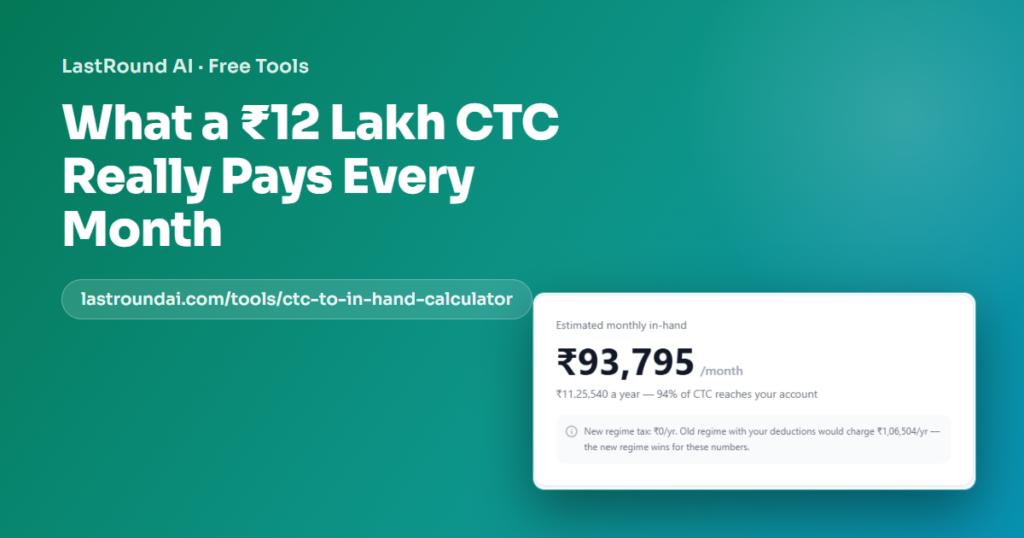
A friend of mine accepted a ₹12 lakh offer last month and budgeted for a lakh a month. His first salary credit was ₹93,795. Nothing was wrong with the payslip. That gap is just what CTC does, and I’ve watched the same surprise land on fresher batches at Infosys through mid-level switches at product companies all the way to people negotiating ₹40 lakh offers who still can’t say what their in-hand salary will be.
The math isn’t secret. It’s just spread across four different documents (your offer annexure, the Income-tax Act, the EPF scheme, and your state’s professional tax slab), so almost nobody assembles it. Here’s the whole thing in one place, using FY 2026-27 rules.
Where the money actually goes
We computed these with the same engine that runs our free CTC to in-hand calculator, cross-checked against 9 hand-worked reference cases. Assumptions: basic at 50% of CTC, employer PF capped at the statutory ceiling, gratuity provisioned inside CTC, Karnataka professional tax, new tax regime, no variable pay.
| Annual CTC | Income tax (incl. cess) | Your PF contribution | Monthly in-hand | % of CTC you see |
|---|---|---|---|---|
| ₹12,00,000 | ₹0 | ₹21,600 | ₹93,795 | 94% |
| ₹18,00,000 | ₹1,37,303 | ₹21,600 | ₹1,31,151 | 87% |
| ₹30,00,000 | ₹4,46,550 | ₹21,600 | ₹2,02,975 | 81% |
Two things jump out. The ₹12 lakh row pays zero income tax (more on that below). And the percentage you keep falls as CTC grows, which matters when you’re comparing a ₹18 lakh offer against your current ₹15 lakh: the raise is real, but it’s smaller in-hand than it looks on paper.
How much of CTC is in-hand salary?
Between 70% and 94% of CTC reaches your bank account, depending on structure and tax bracket. At ₹12 lakh with a standard structure you keep about 94% because income tax is nil; at ₹30 lakh you keep roughly 81%; heavy variable pay or employer NPS inside CTC pushes the monthly figure lower still.
The deductions come in two flavors. Some parts of CTC were never cash in the first place: the employer’s PF contribution, the gratuity provision (4.81% of basic), insurance premiums, and any variable pay that gets settled quarterly or annually, usually below 100%. Then the actual deductions hit what’s left: income tax via TDS, your own PF contribution, and professional tax (₹200 a month in most southern states, zero in Delhi and UP).
The ₹12.75 lakh cliff
Under the new regime, the Section 87A rebate makes your tax nil up to ₹12 lakh of taxable income. Add the ₹75,000 standard deduction and a salaried person pays zero income tax up to ₹12.75 lakh of gross salary. Budget 2026 left all of this unchanged, so it holds for FY 2026-27.
Just past the cliff, marginal relief catches you: earn ₹12.10 lakh taxable and you owe the ₹10,000 excess (plus cess), not the ₹61,500 the slabs would suggest. The relief runs out around ₹12.7 lakh. If you’re negotiating an offer near this line, a ₹50,000 bump in fixed salary can be worth almost all of itself, which is not true anywhere else on the curve. The full slab structure is on the Income Tax Department’s site.
PF: one toggle, thousands of rupees
Employers calculate PF one of two ways. Most cap it at the statutory wage ceiling of ₹15,000 a month, which fixes both contributions at ₹1,800 a month. Some compute 12% of your full basic instead. On a ₹15 lakh basic that’s ₹15,000 a month each side versus ₹1,800, and since the employer share sits inside your CTC, the choice moves your monthly credit by thousands. Your offer annexure states which one applies; the EPF Scheme 2026 made contributions above the ceiling explicitly voluntary.
Related change people keep missing: the labour codes in force since November 2025 require basic plus DA to be at least 50% of pay. Older offers still float around with 40% basic. A higher basic means more PF and more gratuity, so two offers with identical CTC can pay noticeably different monthly amounts.
What I’d actually check before signing
Four lines in the annexure: basic as a % of CTC, whether PF is capped, how much of CTC is variable, and whether gratuity or insurance premiums sit inside the number. Then run it. Our calculator does the FY 2026-27 math client-side (nothing you type leaves the browser) and includes a hike comparison, since an appraisal typically moves you 8-12% while a switch commonly lands 20-40%. And if you’re mid-switch, the interviews are what set the number in the first place; that part we build tools for too, starting with the AI Interview Copilot.
I’ll admit the model has edges. ESI below ₹21,000 gross, employer NPS, LWF, and old-regime HRA math can each shift the figure, and no calculator knows your employer’s exact structure. But it’ll land within a few hundred rupees for most tech offers, which is a lot closer than dividing CTC by 12 and hoping.
The next time someone tells you their salary, ask which number they mean. Odds are they don’t know either.

Written by
Uma Mahesh Bandaru
Writes about live interviews, sales calls and meetings, and how real-time AI assistance changes each of them.