
The Least-of-Three Rule Behind Every House Rent Allowance Claim


Rules verified against the Income Tax Department’s own new-vs-old-regime FAQ page on 7 September 2026, which states, in close to these exact words, that HRA exemption under section 10(13A) is available only under the old tax regime. That’s itself a small find: section 10(13A) belonged to the Income-tax Act, 1961, which was repealed and replaced by the Income-tax Act, 2025 from 1 April 2026, and the department’s own FAQ page still used the 1961 Act’s section number when I fetched it, more than five months after that Act stopped existing. I couldn’t confirm what the section is called under the new Act from an official source, so this piece keeps calling it “section 10(13A)” throughout, the same way the government’s own page still does, rather than guess at a replacement number.
Thresholds like the ones below move with almost every Union Budget, so check the current figures before you file. This piece covers how the HRA exemption is actually calculated, which cities count as metro for it, when your landlord’s PAN becomes mandatory, and why the exemption disappears completely the moment you pick the new regime.
How the HRA exemption is actually computed
The rule, call it Section 10(13A) read with Rule 2A of the Income-tax Rules, since that’s the label everyone, including the government’s own current documents, still uses, exempts the smallest of three amounts, not the full HRA you receive. The three are: the actual HRA paid to you by your employer, the rent you actually pay minus 10 percent of your salary, and 50 percent of salary if you live in a metro city or 40 percent if you don’t. Whichever of those three numbers is lowest is what you get to exclude from taxable income. The other two don’t matter once the smallest one is identified.
The Income Tax Department’s own ITR-2 validation rules for AY 2026-27, published 26 May 2026, almost two months after the Income-tax Act, 2025 replaced the 1961 Act, confirm the same cap using that same old label in its own dropdown-field text: under the old regime, the HRA exemption claimed in a return cannot exceed the lower of the actual house rent allowance received or 50 percent of basic salary and dearness allowance. That specific document doesn’t spell out the 40 percent non-metro figure on its own; that number comes from Rule 2A of the Income-tax Rules itself rather than anything I could point to directly on incometax.gov.in, so if you’re right on the edge of a metro or non-metro call, check the Rule’s text (and its current section number) rather than taking my word for either one.
What “salary” means in this formula
“Salary” here means basic pay plus dearness allowance if your DA counts toward retirement benefits, plus any fixed-percentage commission on turnover. Most private-sector employees in India don’t get a DA component at all, so for most readers, salary in this formula is just basic pay. Worth double-checking your own slip before you assume that, though.
A worked example: same rent, two different cities
Take someone earning 9,00,000 a year in basic pay, receiving 5,00,000 in annual HRA, and paying 40,000 a month, 4,80,000 a year, in rent. The rent-minus-10-percent limb comes to 4,80,000 minus 90,000, which is 3,90,000. If this person works in Mumbai, the metro limb is 50 percent of 9,00,000, or 4,50,000, so the exemption is the smallest of 5,00,000, 3,90,000 and 4,50,000, which is 3,90,000. Move the identical job, identical rent and identical salary to a non-metro city and the percentage limb drops to 40 percent, or 3,60,000, which is now the smallest number and becomes the exemption instead. Same person, same rent, same pay, and the city alone is worth 30,000 rupees of exemption either way.
What happens when rent is low relative to salary
The rent-minus-10-percent limb can go negative, and when it does, the exemption floors at zero rather than turning into a bonus. Take someone earning 12,00,000 in basic pay and paying a modest 8,000 a month, 96,000 a year, in rent. Ten percent of salary is already 1,20,000, more than the rent itself, so the limb works out to a negative 24,000. The exemption in that case is zero, not negative 24,000, even though this person genuinely pays rent every month. High earners with cheap rent, a common combination for someone still sharing a flat early in their career, often get no HRA exemption at all for exactly this reason, and most people never find out why until they actually run the formula.
Which cities actually count as metro
Only four cities count as metro for this specific rule: Mumbai, Delhi, Kolkata and Chennai. That’s it. Bangalore, Hyderabad, Pune and Gurgaon don’t qualify, no matter how large their rents have grown or how often people call them metros in conversation. An engineer paying Bangalore rent gets the 40 percent limb, the same as someone in a small town, while the 50 percent limb is reserved for exactly those four cities. I think this is the single most common HRA mistake in DIY salary spreadsheets, and it’s an easy one to make since nobody expects a tax rule from the 1990s to still be drawing the map this way.
Rent receipts and when you need your landlord’s PAN
You need actual rent receipts, or a rent agreement plus payment proof, to claim this exemption at all. If your annual rent is 1,00,000 rupees or less, roughly 8,333 a month, receipts alone are usually enough. Cross that line and your landlord’s PAN becomes mandatory, reported through what is now Form No. 124 (the form that replaced the older Form 12BB from 1 April 2026 under the new Income Tax Act). No PAN, and your employer can, and often will, refuse to apply the exemption to your monthly TDS, leaving you to claim it later while filing your return instead, assuming you can still produce everything asked for.
This documentation requirement sits alongside the regime declaration itself, which the Income Tax Department’s own return-applicability page confirms defaults to the new regime unless you actively choose the old one, so the HRA paperwork is wasted effort if you forget that second step.
If your landlord genuinely doesn’t have a PAN, and some older landlords still don’t, the usual workaround is a signed declaration from them stating that fact along with their name and address, which you then attach to your own submission. It’s not a loophole so much as an acknowledgment that the rule was written for a country where PAN penetration still isn’t universal. Employers vary in how comfortable they are accepting that declaration for payroll purposes, though, so ask early in the financial year rather than in March when there’s no time left to fix a rejected claim.
Why the exemption disappears entirely under the new regime
The Income Tax Department’s own FAQ page is unambiguous: pick the new regime and section 10(13A) simply doesn’t apply to you. Not reduced, not capped, gone. Your employer still pays you HRA in cash every month if it’s part of your package, but every rupee of it gets added straight to taxable salary and taxed at your slab rate, exactly like special allowance.
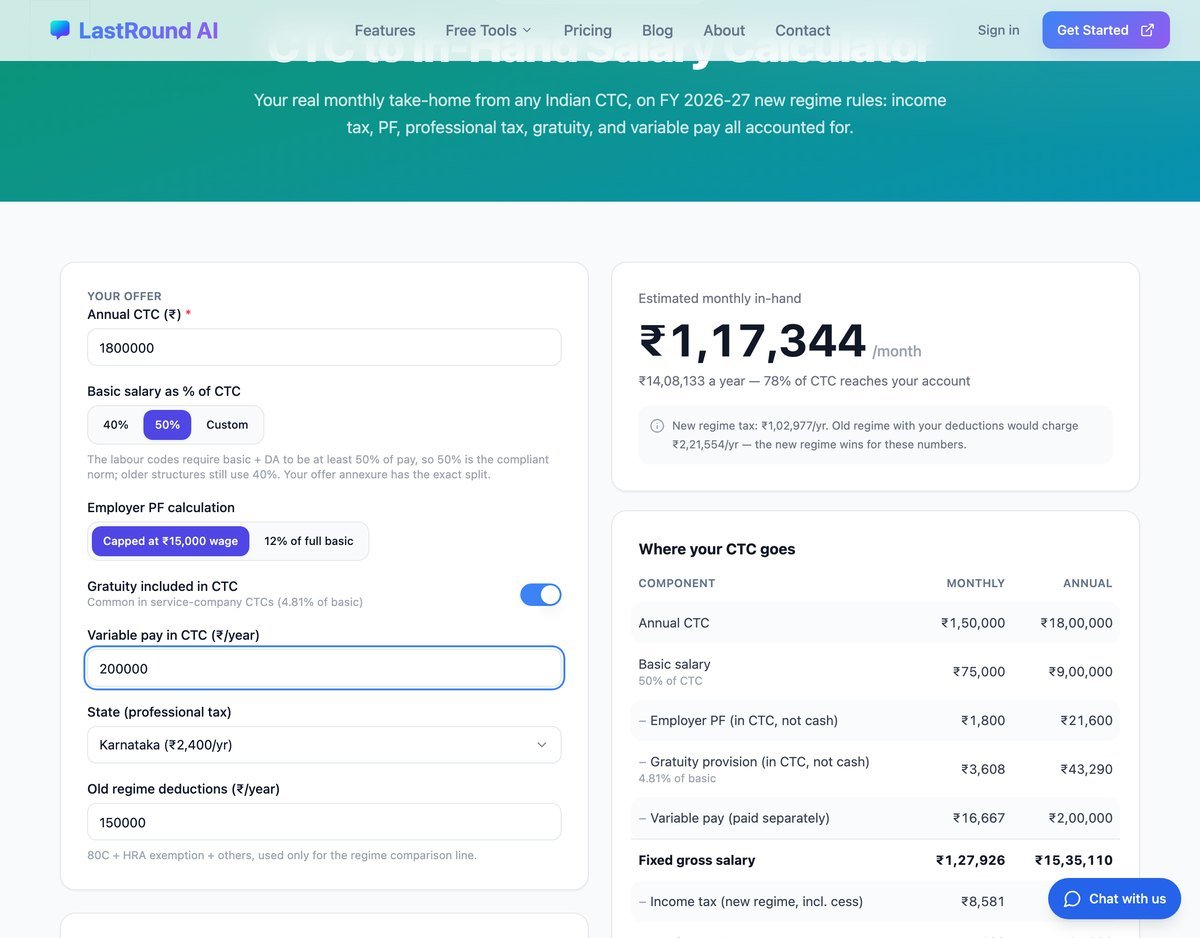
That Rs 1,17,344 monthly figure already assumes no HRA exemption whatsoever, since it’s a new-regime number. Someone on the identical CTC who declares the old regime, pays real rent and keeps proper receipts could, depending on their actual rent and city, take home more or less than that once you run the old regime’s slab rates and exemptions against it. There’s no single answer that fits everyone, which is exactly why this needs its own calculation rather than a rule of thumb.
What this means when you’re comparing offers
If two offer letters show the identical CTC and one of them lets you keep the old regime while paying meaningful rent in a metro city, don’t assume the new regime is automatically better just because it has lower headline slab rates. Run both. LastRound AI’s CTC to in hand salary calculator gives you the new-regime number in a few seconds, which at least tells you the floor you’re comparing against before you sit down with the old regime’s HRA and 80C math by hand.
Common situations that trip people up
Living in a house you own, anywhere, with no rent paid to anyone, gets you zero HRA exemption, full stop, even if your employer keeps paying the allowance every month as part of your salary structure. The exemption exists to offset actual rent, not to reward homeownership.
Paying rent to a parent is allowed, and plenty of people do it legitimately, but it only survives scrutiny with a real rent agreement, real bank transfers rather than cash, and your parent declaring that rent as income on their own return. Skip any one of those three and it stops looking like rent and starts looking like a paper transaction designed to shave your tax bill, which is exactly what assessing officers are trained to look for.
Two-property claims and mid-year job changes
Owning a home in one city while renting in another, common for people who bought a flat in their hometown and then took a job somewhere else, lets you claim HRA exemption on the rent you pay and, separately, a deduction on the home loan interest for the house you own. The two aren’t mutually exclusive under the old regime, since they’re addressing two different facts: where you actually live, and what you actually owe a bank.
Switching jobs mid-year adds one more wrinkle worth flagging. HRA exemption is computed month by month based on the salary and rent applicable in each month, not on a single annual figure, so a job change partway through the year, a rent increase, or a move to a different city all mean the calculation should be redone in pieces rather than averaged across twelve months. Payroll software usually handles this automatically. A manual spreadsheet built once in April usually doesn’t, which is one more reason to recheck the number whenever anything about your job or your address changes.
None of this is tax advice, and the calculator is an estimator, not a filing tool. For the full worked arithmetic behind a new-regime CTC breakdown, LastRound AI’s CTC to in hand salary breakdown for FY 2026-27 and the CTC versus in hand salary regime comparison both cover ground this piece doesn’t.

Written by
Krishna Naga
Writes about hiring processes at large tech companies and how candidates can prepare for them.