
Reading an Indian Payslip Without Guessing What Each Line Does


An Indian offer letter usually lists ten or so line items under CTC. The payslip that shows up in your inbox every month lists a different, shorter set, and a few of the CTC lines never appear on it at all. This is a line-by-line reference for the nine salary slip components you’ll actually run into: what each one is, whether it’s taxed, and whether it moves the number that lands in your bank account.
The figures below come from a real run of LastRound AI’s CTC to in hand salary calculator on 6 September 2026, for an 18,00,000 rupee CTC in Karnataka: 21,600 a year in employee PF, 43,290 in gratuity provision, 2,400 in professional tax. Yours will differ by employer and state, but the mechanics behind each line are identical everywhere in India.
One more thing worth flagging up front: the section numbers this piece cites for old-regime deductions (80C, 16(iii), and, later, 87A) are their labels under the Income-tax Act, 1961. That Act was repealed and replaced by the Income-tax Act, 2025 from 1 April 2026, which renumbered most of the Act along the way. Rules verified against incometax.gov.in on 7 September 2026; I could not confirm the new section numbers against an official source, so treat every old section number here as the familiar label for a mechanism that’s still very much alive, not a citation you should quote as current.
The nine salary slip components, one by one
Some of these show up every month. A couple show up only on the CTC sheet HR hands you at joining, and never on a monthly slip at all.
Components that show up on your monthly slip
| Component | What it is | Taxable? | Changes your in hand pay? |
|---|---|---|---|
| Basic pay | The base figure everything else is calculated from: PF, gratuity, often HRA too. | Fully taxable, both regimes. | Yes, paid out in full each month. |
| HRA | House rent allowance, meant to offset rent. | Partly exempt under the old regime via the least-of-three rule; fully taxable under the new regime. | Yes, paid monthly regardless of regime; only the tax on it changes. |
| Special allowance | The balancing figure that tops fixed pay up to the number in your offer letter. | Fully taxable, both regimes, no exemption exists for it. | Yes, paid in full and taxed at your slab rate. |
| LTA | Leave travel allowance, meant to cover travel costs for one trip. | Exempt twice in a four-year block under the old regime, with travel bills; fully taxable under the new regime. | Often bundled with your last payslip or paid only after you submit travel proof, so it doesn’t always land with the rest of your monthly pay. |
| Employee PF | Your own mandatory 12 percent contribution, usually capped at the 15,000 wage ceiling. | Not itself taxed as income; qualifies for the old Section 80C deduction, old regime only. | Yes. It’s the deduction most people forget exists until they see the slip. |
| Professional tax | A small state-levied tax, capped annually by each state’s own Act. | Deductible from taxable salary under the old Section 16(iii), old regime only; still deducted from your pay under either regime. | Yes, a small fixed monthly amount. |
| TDS | Tax deducted at source, your employer’s monthly estimate of your annual tax bill. | It is the tax. | Yes, usually the single largest deduction on the slip once you’re above the old Section 87A rebate line. |
Components that live only on the CTC sheet
These two never appear on a monthly payslip at all. They sit inside the CTC figure your offer letter quoted, and that’s the only place you’ll ever see them as a rupee number.
| Component | What it is | Taxable? | Changes your in hand pay? |
|---|---|---|---|
| Employer PF | Your employer’s 12 percent provident fund contribution. | Not treated as your salary income today; interest earned above 2.5 lakh of your own yearly contribution is taxable, which is a separate, narrower rule. | No. It goes to your EPF account, never your bank account, until you exit or retire. |
| Gratuity provision | Your employer setting aside roughly 4.8 percent of basic per year toward an eventual gratuity payout. | Exempt up to 20,00,000 rupees on actual receipt, under the Payment of Gratuity Act; untaxed while it’s just a provision. | No. It never touches monthly pay, and most people who leave before five years of service never collect it at all. |
What that looks like in rupees
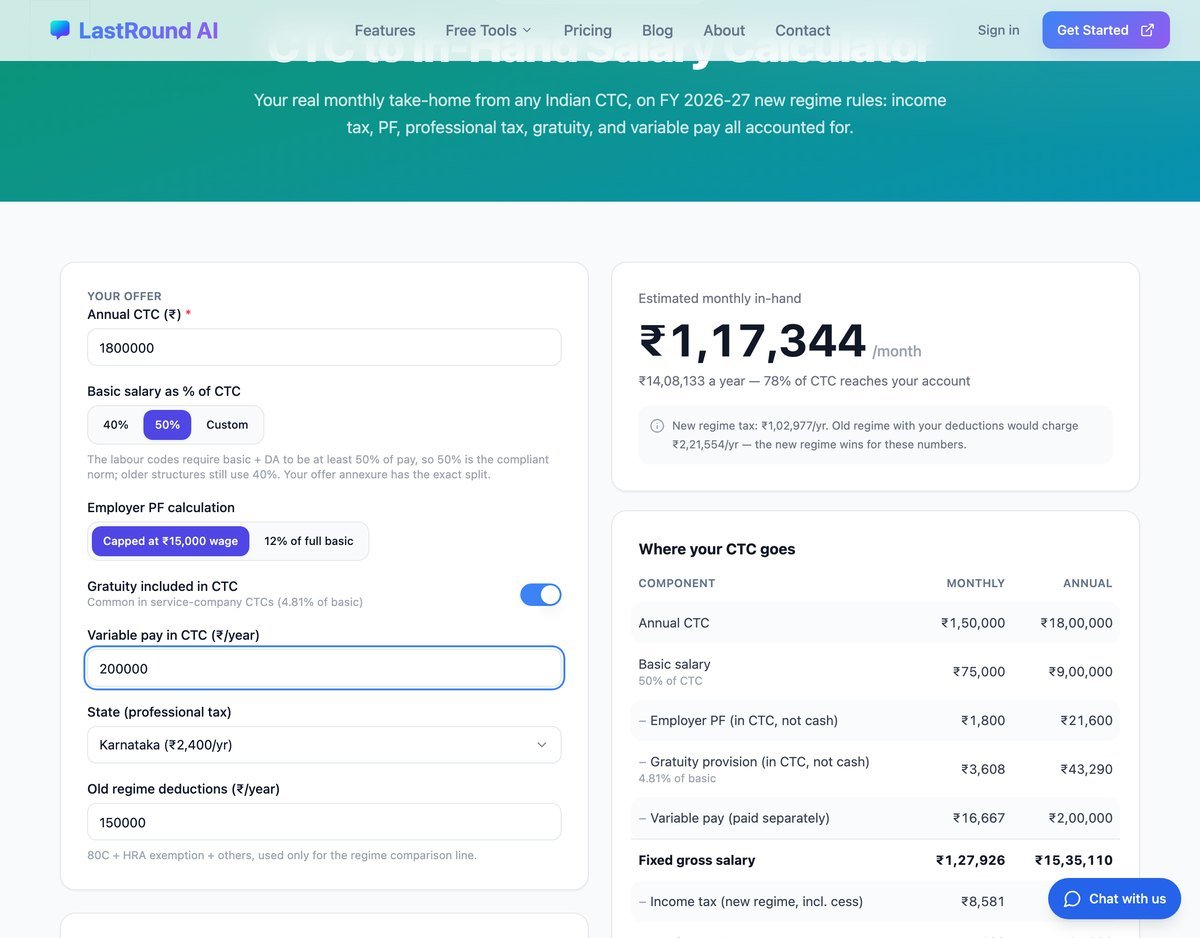
On the 18,00,000 CTC run above, basic pay and special allowance together made up most of the roughly 15,35,000 rupees actually paid out over the year before tax. Employee PF took 21,600 of that off the top before it ever reached a bank account, professional tax took another 2,400, and TDS on the remaining taxable income took roughly 1,02,977 after the 4 percent cess. What was left, divided by 12, is the Rs 1,17,344 that showed up as the monthly in hand salary. Employer PF and gratuity provision never entered that calculation at the paid-out stage at all, because they were subtracted earlier, on the way from CTC down to gross salary paid. That’s the whole trick to reading any slip: work out which stage of the calculation a line belongs to before asking whether it should worry you.
Which lines are actually taxable
Basic pay, special allowance and TDS itself are taxable no matter which regime you pick. HRA, LTA and professional tax are where the regime you choose actually matters. Under the old regime, all three can reduce what the taxman sees, HRA and LTA through exemptions, professional tax through a direct deduction under the old Section 16(iii). Under the new regime, none of the three do anything for your tax bill, even though HRA and LTA still get paid to you in cash and professional tax still gets deducted from your pay either way. That’s the part people miss: losing an exemption doesn’t mean losing the money, only losing the tax break on it.
Employer PF sits outside this question entirely, because it was never your income to begin with. Gratuity provision is untaxed for a simpler reason: nothing has actually been paid to you yet.
The two lines that never touch your in hand pay
Employer PF and gratuity provision are the answer. Both are real money, both show up in your CTC number, and neither ever appears in your bank account on payday. Everything else on this list, basic, HRA, special allowance, LTA, employee PF, professional tax and TDS, either adds to or subtracts from what actually lands in your account every month. If you’re trying to reconcile your CTC against your bank statement and the math won’t close, these two lines are almost always where the gap hides.
Why two people on the same CTC get different slips
Since the new regime became the default a few years ago, your employer withholds TDS assuming the new regime unless you tell them otherwise, usually through a declaration form at the start of the financial year (Form 12BB was replaced by Form 124 from 1 April 2026 under the new Income Tax Act, though the underlying idea is unchanged). Two employees on an identical 15,00,000 CTC can see meaningfully different monthly TDS if one declares the old regime with rent receipts and 80C investments and the other stays on the new regime by default. Neither slip is wrong. They’re just running different tax elections on the same salary structure.
This is also why comparing your slip against a friend’s, even at the identical CTC and the identical employer, rarely tells you anything useful. Their basic-to-special-allowance split might differ, their state’s professional tax might differ, and their regime declaration almost certainly differs from yours unless you both filled out the same form the same way in April. A payslip is a personal document dressed up as a standard one.
LastRound data
What to actually check on your own slip
Four of these salary slip components are worth five minutes of your time each time you get a fresh one. Confirm your PF is calculated on the wage base you expect, the 15,000 ceiling or your actual basic, since employers now have a real choice here after the Employees’ Provident Fund Scheme, 2026 took effect. Confirm professional tax matches your state’s own slab rather than a number copied from a template built for a different state. Check whether LTA got quietly folded into taxable special allowance because you never submitted travel proof. And check that the regime your payroll system is using actually matches the one you meant to declare, because a mismatch there is the most common reason take-home pay surprises people at the start of a new financial year.
Sources worth rechecking every year
Rules verified against incometax.gov.in’s new-vs-old-regime FAQ page on 7 September 2026, which confirms HRA is unavailable under the new regime. The Income Tax Department’s AY 2026-27 slab page confirms the current new-regime brackets. I could not get epfindia.gov.in to load on the same day to quote the wage ceiling in its own words, so that fact is corroborated through payroll-compliance trackers rather than a direct fetch, and I’m saying so rather than pretending otherwise. None of these numbers are permanent. The Union Budget changes at least one of them most years, so treat this as a map of the mechanism, not a value to copy into a spreadsheet three years from now.
For the full worked arithmetic behind an 18 LPA CTC broken down to a monthly number, LastRound AI’s CTC to in hand salary breakdown for FY 2026-27 walks through every step. And if you’re deciding which regime to declare in the first place, CTC versus in hand salary under the old and new regime covers when the older option still wins.

Written by
Hari Priya Vemula
Covers interview preparation and the candidate experience, from the first screen through to the final round.