
What a Job Posting Is Actually Trying to Tell You


Knowing how to read a job description properly saves you the hour you’d otherwise spend tailoring a resume for a role that was never really open, or was open to someone with a title two levels above yours. Most postings bury the real requirements inside a wish list of twelve to eighteen bullet points, and treating all of them as equally mandatory is the single most common reason strong candidates skip roles they’d actually get.
How to read a job description: start with the reality check
Before you read a single requirement, ask what kind of opening this actually is. A backfill for someone who left reads differently from a brand new headcount tied to a funding round or a product launch. Backfills tend to have tighter, more specific language, often mirroring the exact stack the previous person used, because the hiring manager already knows precisely what gap needs filling. New headcount postings read looser and more aspirational, because nobody has done the job yet to know what it actually requires day to day. With the Bureau of Labor Statistics projecting 10 percent employment growth for software developers between 2025 and 2035, expect the aspirational, new headcount kind of posting to keep outnumbering tight backfills across the industry, not the other way around.
You can usually tell which one you’re looking at from how specific the tooling mentions are. A posting that names an exact internal system, a specific vendor, or a niche library rather than a category (Kubernetes rather than container orchestration, for instance) is very likely describing a real seat with a real predecessor, not a wish list drafted by a hiring manager guessing at what the team might need.
Separating genuine must-haves from wish-list padding
Real must-haves cluster near the top of the requirements section and repeat, in different words, somewhere else in the posting, usually in the role summary. If a skill only appears once, buried at bullet nine of fourteen, it’s much more likely padding than a genuine filter. Recruiters and hiring managers often draft the requirements list by committee, folding in a line each stakeholder wanted included, and nobody goes back to prune it.
A useful rule of thumb: if removing a requirement would change who the hiring manager pictures doing the job, it’s a must-have. If removing it changes nothing about that picture, it’s padding. Five years of experience with a tool that’s been publicly available for three years is the clearest tell of padding there is, and it shows up constantly.
Year counts attached to specific frameworks are the easiest padding to catch, because you can check them against a release date in about ten seconds. A framework three years old cannot honestly need five years of experience with it, and a posting asking for that is either copy pasted from an older template for a different tool, or written by someone outside engineering who doesn’t know the timeline. Neither case means the role is fake. It usually just means nobody proofread the requirements against reality before the posting went live.
Nice to have really does mean nice to have
Sections explicitly labeled preferred, nice to have, or a plus almost always mean exactly that. Companies that wanted these skills as hard requirements would have put them in the must-have list. Applying without every item in this section is the posting working as intended, and skipping it over a missing nice-to-have is the actual gamble.
Reading seniority from the verbs, not the title
Titles are inflated more often than descriptions are. A posting titled Senior Engineer that uses verbs like assist, support, and contribute under a mentor’s guidance is describing something closer to a mid level role dressed up for a specific pay band or a client contract that required a senior title. A posting titled Engineer II that uses verbs like own, lead, define, and drive is quietly describing a senior role that HR hasn’t gotten around to retitling yet.
Own and define signal genuine ownership over a decision. Support and assist signal you’ll be executing someone else’s decision. Count which family of verbs dominates the responsibilities section, not the requirements section, and you’ll get a more honest read of the actual seniority than the job title gives you.
Spotting a role that isn’t really open
A ResumeBuilder.com survey of 1,641 hiring managers, run in May 2024, found that 40 percent said their company had posted a fake job listing in the past year, and 30 percent had one live at the time they were surveyed, most often to project growth, collect resumes for later, or make current staff feel replaceable. Keep applying anyway, just read a posting that’s been live for months, on a role with an oddly generic team name, with more suspicion than one that’s three days old and names a specific manager or team.
A hybrid role description deserves the same scrutiny. Three days a week in a city with no local office listed, or a role that names a specific in-office collaboration need while also advertising for candidates across an entire country, usually means the policy hasn’t been finalized internally, or that it varies by team in a way the posting doesn’t admit. Ask about it directly in a screening call rather than assuming either the generous or the strict reading.
What the requirements tell you about the interview rounds ahead
A posting heavy on system design language, terms like scalability, distributed, and high availability, usually means a system design round is coming, even for roles a couple of levels below where you’d expect one. A posting that lists specific frameworks and asks for take home assignment experience is telling you a practical coding round, not a whiteboard one, is likely.
Behavioral emphasis shows up as language about stakeholder management, cross functional work, and ambiguity. If three or more bullets touch on working with other teams rather than writing code, expect at least one round built entirely around behavioral questions, not just five minutes tacked onto the end of a technical interview.
The number of distinct skill categories listed also hints at the panel size. A posting that touches backend, infrastructure, and a specific cloud vendor by name is often staffed by three separate interviewers covering three separate rounds, not one generalist covering everything in forty five minutes. I don’t have a formula that converts bullet count directly into round count. It’s closer to a smell test than a calculation, and it gets more reliable the more postings you read from the same company.
A worked example: breaking a real posting into three parts
LastRound AI’s job description analyzer does this splitting for you, sorting a pasted posting into a role reality check, a must-have skills list, and a nice-to-have list. Opening it on 6 September 2026 against a real posting produced exactly that three way breakdown, separating the handful of requirements that showed up in both the summary and the requirements section from the longer tail that appeared only once.
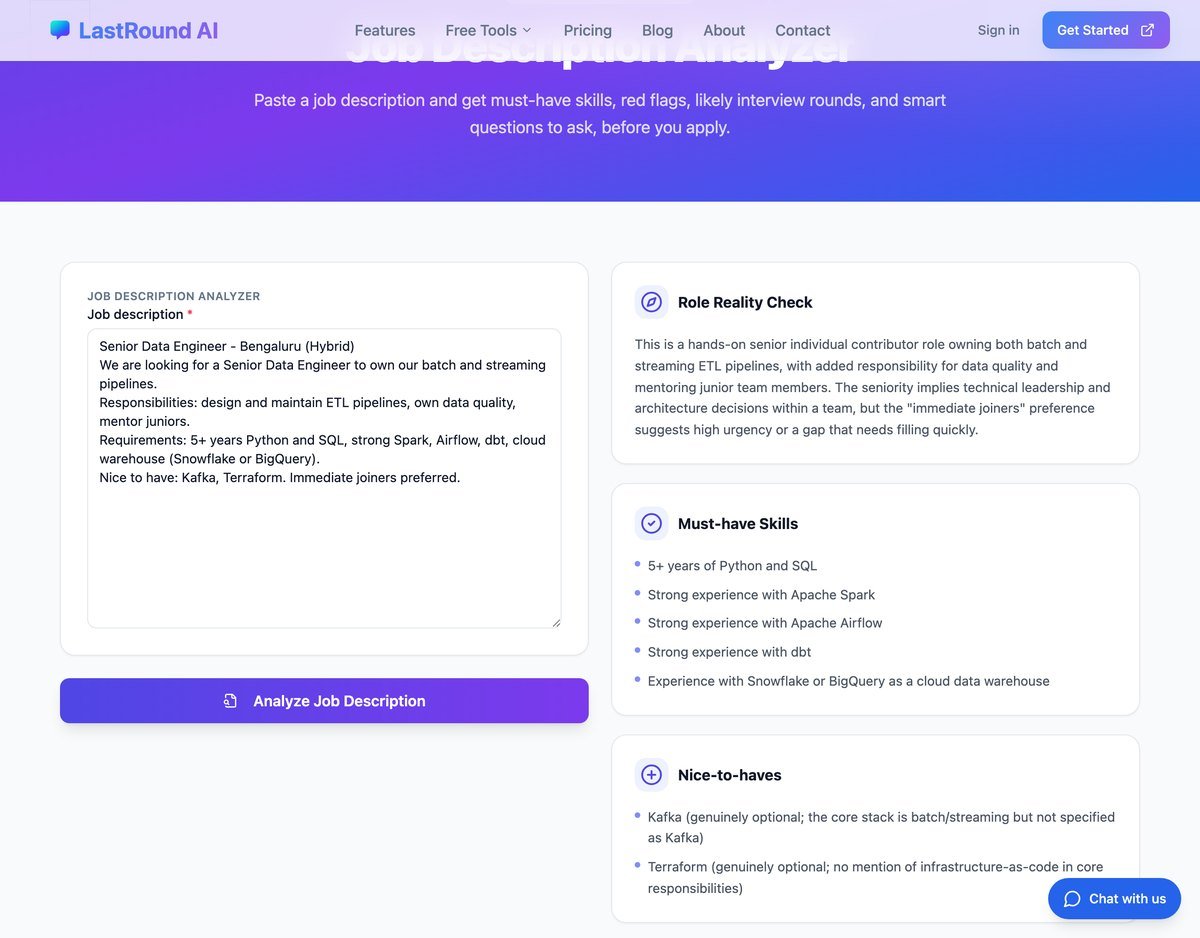
Doing this manually takes maybe five minutes once you know what to look for: read the summary first, circle anything that repeats in the requirements, then separate what’s left into padding and preferred. It’s not a complicated method. Most people just never do it, because a fourteen bullet requirements list feels like it demands to be read top to bottom and taken at face value.
Deciding whether to apply at all
Apply if you meet most of the repeated, specific must-haves and can speak honestly to the verbs in the responsibilities section, even if half the nice-to-have list is unfamiliar to you. Skip, or apply with much lower expectations, when the posting is vague everywhere it should be specific, has been live for months with a generic team name, or asks for a contradictory mix of senior ownership language and junior year counts in the same paragraph.
Give yourself a hard limit of five minutes to make this call, the same five minutes the analyzer takes to do it for you. Spending twenty minutes debating whether a posting is worth an hour defeats the entire point of reading it quickly in the first place. If you’re still undecided after five minutes, the honest answer is usually apply, since a rejected application costs you almost nothing and a skipped opportunity you’d have gotten costs you a job.
None of this is a guarantee. A posting can pass every one of these checks and still be attached to a hiring manager who ghosts every applicant, a pattern our own look at ghost jobs in 2026 covers in more detail, and our ghost job detector guide goes further into spotting the postings that were never real to begin with. Reading the description well just narrows which hour long applications are worth writing, and that’s most of what you can control before a recruiter ever opens your resume, a step our guide to how ATS parses a resume picks up from here.

Written by
Dhanush
Writes about the engineering behind real-time conversation tools and how they hold up in practice.