
How Long Do Job Postings Stay Up? We Checked 67,435 of Them

One job posting in our data went live on 16 March 2015. Its title is “Name Your Job.” On 9 October 2026, when we last checked, it was still open. That’s 4,224 days.
It’s an extreme case, but it isn’t a lonely one. We pulled every open posting from 1,891 companies that publish their jobs through Greenhouse and Lever, 67,435 listings in total, and looked at how long they’d been up. The short version: about 1 in 5 open jobs has been listed for more than six months. That’s the closest thing to a measurable number for “ghost jobs” we could build from public data, and it’s a lot higher than I expected.
What counts as ghost jobs in this study?
For this study, a ghost job is an open posting that has stayed live for more than 180 days. That’s a deliberately blunt definition. Some of those roles are genuinely hard to fill and still being recruited for. Others are talent-pool listings that will never turn into a single hire. From the outside, a candidate can’t tell the difference, and that’s the problem.
We can’t see inside anyone’s applicant tracking system. What we can see is the date each posting was created and whether it’s still public. So treat every number below as “how long jobs stay up,” which is the thing a job seeker actually experiences, and not as proof that a company has no intent to hire.
How we built the snapshot
Both vendors publish open job board APIs. Lever’s public postings API returns a createdAt timestamp on every posting. Greenhouse’s job board API exposes updated_at and first_published, and our crawler stores updated_at, which resets whenever a recruiter edits a listing. That makes Greenhouse ages look younger than they are. So every age figure in this post uses the 33,562 Lever postings (834 companies) only. Greenhouse postings count toward totals and nothing else.
Three more decisions shape the results, and you should know about all of them:
- We removed 430 postings from Lever’s own internal training board. It isn’t a real employer.
- Nine companies hold 7,111 postings older than six months between them. One specialty retailer alone had 3,573 store roles over that age, out of 3,738 open. Those are evergreen listings kept open to collect applicants year round, and they’d swamp everything else. The headline numbers exclude those nine. The raw numbers are shown too.
- The crawl reached 3,049 of the 9,935 company boards we track before we froze it. This is a sample of Greenhouse and Lever employers, not the whole job market.
How long do job postings stay up?
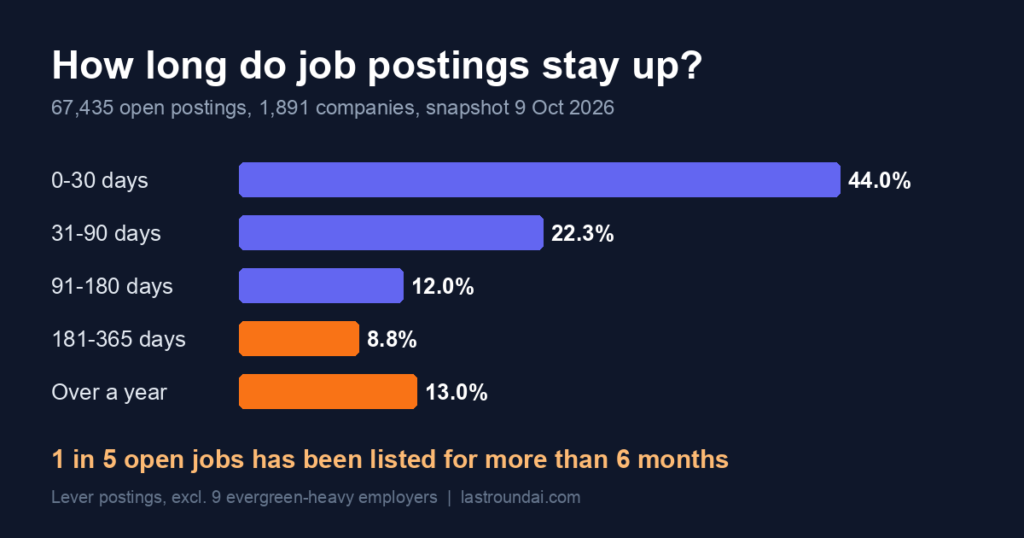
Half of all open Lever postings in the sample have been live for 42 days or less. The other half is where it gets uncomfortable: 21.8% have been up for more than six months, and 13.0% for more than a year.
| Posting age | Postings | Share | |
|---|---|---|---|
| 0 to 30 days | 10,914 | 44.0% | |
| 31 to 90 days | 5,530 | 22.3% | |
| 91 to 180 days | 2,973 | 12.0% | |
| 181 to 365 days | 2,192 | 8.8% | |
| Over a year | 3,215 | 13.0% |
Lever postings, 24,824 jobs, excluding the nine evergreen-heavy employers. Snapshot taken 9 October 2026.
Put the nine back in and it looks far worse: 37.3% of postings older than six months, a median age of 78 days. I think the lower figure is the fairer one for most job seekers, because most people aren’t applying to store associate roles at a single retailer. But if you are, the higher number is your reality.
The company view tells the same story from another angle. Of the 628 companies with at least five open Lever postings, 24.4% have a median posting age above 180 days. For roughly one employer in four, the typical open job on their careers page is older than six months.
Remote jobs vanish about 4 times faster
This was the result I didn’t see coming.
| Postings | Median age | Older than 6 months | |
|---|---|---|---|
| Remote | 7,650 | 14 days | 12.3% |
| On-site or hybrid | 17,174 | 59 days | 26.0% |
A remote posting’s median age is 14 days. On-site is 59. My guess is that remote roles get flooded with applicants so quickly that companies close them within two weeks, while on-site roles in specific cities sit open for months waiting for someone local. I can’t prove that from posting dates alone, and there may be a labeling effect too (we flag a job as remote when the location or Lever’s workplaceType field says so). Still, the practical takeaway holds either way: if a remote job you like went up last week, apply now. It may be gone by the weekend.
Is it different by country or seniority?
Less than you’d think. US postings have a median age of 50 days with 22.4% older than six months. The UK is a bit worse (57 days, 26.6%), Canada a bit better (42 days, 15.9%). The UK and Canada samples are small, 534 and 1,086 postings, so I wouldn’t lean on that gap.
Seniority is more interesting. Entry-level postings are younger on median (31 days against 63 for senior roles), yet the share older than six months is almost identical: 23.1% for entry-level, 23.0% for senior. So the fresh entry-level roles disappear fast, and the ones that stick around stick around just as long as senior ones.
There also aren’t many of them. Across all 67,435 postings, titles with senior markers (senior, staff, principal, lead, director and similar) outnumber entry markers (junior, intern, graduate, entry-level, trainee) by about 6.1 to 1: 11,501 against 1,897. That’s a rough keyword count. Most titles carry no seniority word at all, so it says more about how employers label roles than about total hiring. Our August snapshot pointed the same way, with roughly 4 senior roles per entry-level one.
Old postings disclose salary more often, not less
We expected stale listings to be the low-effort ones. The pay data says otherwise. Among Lever postings older than six months, 39.4% carry a salary range. Among postings 30 days old or newer, it’s 27.6%.
Part of that is geography. 51.3% of US Lever postings include a range, against 27.3% in Canada and 15.9% in the UK, and US postings skew older. Pay transparency laws in several US states push employers to publish ranges on every listing, old or new. If you want the full breakdown by vendor and country, our pay transparency study covers 101,432 postings from August, and there’s a separate piece on why Greenhouse’s job board API has no salary field at all.
How to spot ghost jobs before you apply
Check the posting date before you spend an hour on a cover letter. Anything older than three months deserves a quick sanity check: is the same role still listed on the company’s own careers page, and did anyone at the company post about hiring for it recently?
Prioritize new listings, remote ones especially. Our data says a remote role posted 10 days ago has a much better chance of still being real than an on-site one posted in March. If you’re applying at volume, our Auto-Apply job search sorts newest postings first and you approve every application before it goes out, which keeps you out of the four-year-old listings.
One signal I expected to help turned out not to: duplicates. Lots of advice says that the same title listed three or four times on one board, with slightly different locations, marks a pipeline listing rather than a real seat. We checked. Among postings older than six months, 60.9% sit in a group of three or more same-title listings at the same company. Among postings 30 days old or newer, it’s 55.9%. That gap is too small to be useful. Multi-location hiring is just normal now, so duplicates on their own tell you very little. Posting age is the better tell.
And don’t take a silence from an old posting personally. A posting that’s been up for 400 days was probably never waiting for you specifically.
The data, if you want to check our work
The full snapshot is free to download: lastroundai-ghost-jobs-snapshot-2026-10.csv (67,435 rows: vendor, company, title, location, country, remote flag, salary, posted date, last seen). It’s built only from public job board APIs and contains no personal data. Use it under CC BY 4.0, with a link back to this page. For context on the wider market, the US Bureau of Labor Statistics publishes monthly openings in its JOLTS survey. Our numbers describe listing age, theirs describe volume, and the two together are more useful than either alone.
We plan to repeat this snapshot monthly with the same method. If the 1-in-5 figure moves, we’ll know whether employers are cleaning up their boards or just leaving the lights on.

Written by
Uma Mahesh Bandaru
Writes about live interviews, sales calls and meetings, and how real-time AI assistance changes each of them.