
What 10 LPA, 15 LPA and 20 LPA Actually Pay You Each Month


On 6 September 2026 I ran LastRound AI’s CTC to in hand salary calculator with an 18,00,000 rupee CTC, a Karnataka posting, and 2,00,000 rupees of variable pay. It returned a monthly in hand salary of Rs 1,17,344 on the new tax regime, which is about 78 percent of the CTC’s monthly-equivalent value. Almost nobody expects that gap the first time they see it.
This post works the same arithmetic for 10 LPA, 15 LPA and 20 LPA using the identical method, so you can rebuild your own number from your own offer letter instead of trusting a black box. The 18 LPA figure is the only one that came straight out of a live tool run. The other three bands are computed by hand, using the same formula and the same ratios the calculator applied, and I say so at every step where that matters.
One more thing worth flagging up front: FY 2026-27, the year this piece uses throughout, is the first year governed by the Income-tax Act, 2025, which replaced the Income-tax Act, 1961 from 1 April 2026 and renumbered a lot of familiar sections along the way. Rules verified against incometax.gov.in on 7 September 2026; where a section number below (87A, for instance) is one you recognize from the old Act, treat it as the familiar label for the mechanism, not a claim that the number itself is still current.
The one figure that’s actually verified: Rs 18 LPA
Here is what the calculator showed for an 18,00,000 CTC with Karnataka as the work location. Annual fixed gross came to 16,00,000, meaning the 2,00,000 of variable pay sits outside the guaranteed part of the package entirely. Employee PF landed at 1,800 a month (21,600 a year), because the calculator applies the statutory 15,000 wage ceiling rather than deducting 12 percent of actual basic. Gratuity provision showed as 43,290 a year, a number that never reaches your bank account but still eats into the CTC figure printed on your offer letter. Karnataka’s professional tax came to 2,400 a year.
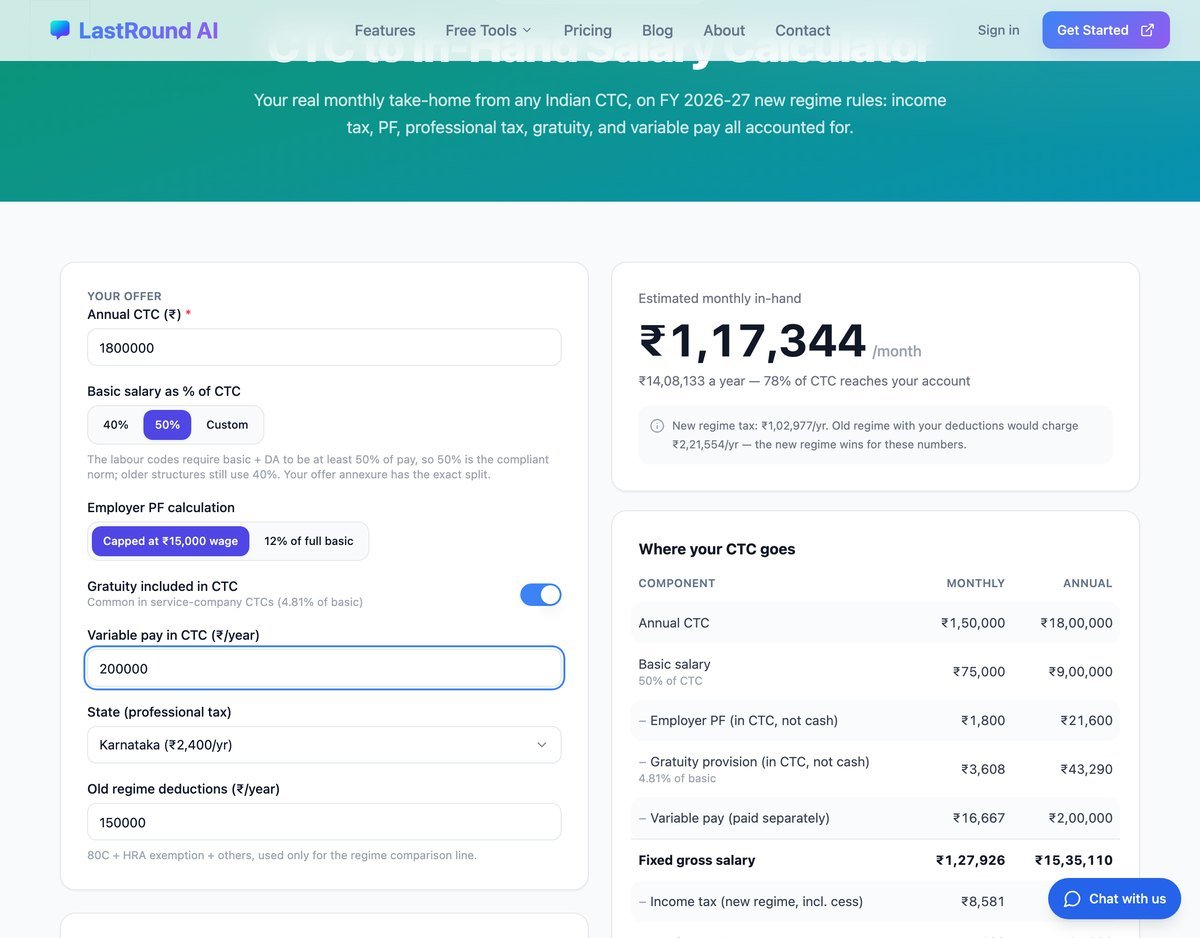
Put those pieces together and the monthly in hand salary comes to Rs 1,17,344. Not a round number, and that’s the point. Real payroll math never lands on a round number.
How to redo this yourself
The calculator’s logic breaks into nine steps. Run through them once with your own offer letter and you will see exactly where your number comes from, instead of accepting whatever a spreadsheet template hands you.
First, pull the variable pay component out of your CTC to get your annual fixed gross (CTC minus variable pay). Second, work out employer PF: 1,800 a month if your employer caps contributions at the 15,000 wage ceiling, more if they contribute on your actual basic. Third, estimate the gratuity provision using the Payment of Gratuity Act formula: basic pay times 15, divided by 26, divided by 12, which works out to roughly 4.8 percent of basic per year. Fourth, subtract both of those from fixed gross to get the gross salary that’s actually paid to you. Fifth, subtract the standard deduction, currently 75,000 under the new regime, to get taxable income.
Steps six through nine: tax, rebate and rounding to a monthly figure
Sixth, apply the FY 2026-27 new-regime slabs: nil to 4 lakh, 5 percent from 4 to 8 lakh, 10 percent from 8 to 12 lakh, 15 percent from 12 to 16 lakh, 20 percent from 16 to 20 lakh, 25 percent from 20 to 24 lakh, and 30 percent above that, confirmed against the Income Tax Department’s own AY 2026-27 slab page.
Seventh, check the rebate that sat at Section 87A under the old Income-tax Act, 1961. That Act was repealed and replaced by the Income-tax Act, 2025 from 1 April 2026, and section numbers moved around in the rewrite. I could not confirm the exact new section number against an official incometax.gov.in source, so treat “Section 87A” here as the familiar old label for the mechanism rather than a live citation, and check the current section before you quote one anywhere formal. The mechanism itself hasn’t changed: if your taxable income is at or under 12,00,000, tax drops to zero. Slightly over that line, marginal relief caps your tax at the amount by which you exceed 12 lakh, not the full slab calculation.
Eighth, add 4 percent health and education cess on whatever tax survives. Ninth, subtract employee PF and professional tax from gross salary paid, then subtract the tax, and divide by 12.
Worked example: 15 LPA, start to finish
Take a 15,00,000 CTC with the same 11 percent variable share. Variable pay works out to 1,66,667, leaving an annual fixed gross of 13,33,333. Employer PF at the 15,000 ceiling is 21,600 a year. Basic pay, on the same ratio the verified run implied, comes to roughly 7,50,470, so gratuity provision (basic times 15, over 26, over 12) is about 36,081.
Subtract employer PF and gratuity from fixed gross and the gross salary actually paid to the employee is 12,75,652. Take off the 75,000 standard deduction and taxable income lands at 12,00,652, which is where this example gets interesting: it crosses that same rebate threshold by only 652 rupees, so marginal relief limits the entire tax bill to roughly that same 652 rupees plus a sliver of cess, instead of the 63,000-odd rupees the slab table alone would suggest. Subtract employee PF, professional tax and that near-zero tax from the gross salary paid, divide by 12, and the monthly in hand salary comes to Rs 1,04,248. Change the variable-pay share by even a percentage point and this number moves to the other side of that cliff.
In hand salary at 10 LPA, 15 LPA and 20 LPA
Using an 11 percent variable-pay share and a basic-to-fixed-gross ratio matched to the verified 18 LPA run, here is where 10, 15 and 20 LPA land. The 18 LPA column is the real, tool-verified number; the rest follow the same steps by hand.
| Metric | 10 LPA | 15 LPA | 18 LPA (verified) | 20 LPA |
|---|---|---|---|---|
| CTC | 10,00,000 | 15,00,000 | 18,00,000 | 20,00,000 |
| Variable pay (assumed) | 1,11,111 | 1,66,667 | 2,00,000 | 2,22,222 |
| Annual fixed gross | 8,88,889 | 13,33,333 | 16,00,000 | 17,77,778 |
| Employer PF | 21,600 | 21,600 | 21,600 | 21,600 |
| Gratuity provision | 24,054 | 36,081 | 43,290 | 48,107 |
| Gross salary paid to you | 8,43,235 | 12,75,652 | 15,35,110 | 17,08,071 |
| Standard deduction | 75,000 | 75,000 | 75,000 | 75,000 |
| Taxable income | 7,68,235 | 12,00,652 | 14,60,110 | 16,33,071 |
| Tax plus 4% cess | 0 (rebated) | 678 (marginal relief) | 1,02,977 | 1,31,679 |
| Employee PF | 21,600 | 21,600 | 21,600 | 21,600 |
| Professional tax | 2,400 | 2,400 | 2,400 | 2,400 |
| Monthly in hand salary | 68,270 | 1,04,248 | 1,17,344 | 1,29,366 |
Look closely and 15 LPA nets a slightly higher share of CTC in hand than 10 LPA does (about 83 percent against 82 percent), which looks backwards until you notice why. The 15 LPA band’s taxable income lands at 12,00,652, just 652 rupees over that same rebate cliff, so marginal relief caps its tax near zero. I think this rule is the single most-skipped line in DIY salary spreadsheets, and it can flip which of two offers actually pays more.
Why the number lands lower than people expect
Three things quietly shrink a number that looked bigger on the offer letter. Variable pay is the obvious one: it’s part of CTC, but it isn’t guaranteed, and companies vary in how much of it they actually pay out each year. Employer PF is less obvious. It’s your employer’s contribution, added into CTC to make the total look larger, but it goes into your provident fund account, not your bank account, until you leave the job or retire. Gratuity provision works the same way and is worse for job switchers: you only get to keep it if you complete five years of continuous service, per the Payment of Gratuity Act, so it can inflate a CTC figure for people who never collect a rupee of it.
Add those two non-cash lines together on an 18 LPA package and they come to roughly 65,000 rupees a year sitting inside the CTC number that will never show up as take-home, no matter how the offer letter is worded.
LastRound data
Two assumptions worth checking against your own offer letter
I used an 11 percent variable-pay share across all four bands here because that’s what the verified run implied. Your employer might structure it at 8 percent, or 20 percent for a sales-adjacent role, and every point of difference moves your fixed gross and your tax bracket. Ask HR directly rather than guessing.
The PF wage ceiling assumption matters even more after 2026. The Employees’ Provident Fund Scheme, 2026, notified by the labour ministry on 29 June 2026, made contributions above the 15,000 wage ceiling voluntary (I could not get epfindia.gov.in’s FAQ page to load on 7 September 2026 to quote its own wording, so this is corroborated through payroll-compliance trackers rather than a direct fetch) rather than something employers quietly default into on actual basic. Some IT employers already cap PF at 1,800 a month either way; others still contribute on full basic, which raises both your PF deduction and your retirement corpus while lowering your monthly in hand number. There isn’t a universal answer here, only a policy your payroll team can confirm in one email.
What can change your number every year
Rules verified against incometax.gov.in on 7 September 2026, and thresholds like these move with almost every Union Budget, so treat this piece as a method, not a permanent lookup table. One thing I found while checking: the Income Tax Department’s own new-vs-old-regime FAQ page still states the new-regime standard deduction as 50,000 rupees when I fetched it that day, even though the figure Budget 2024 actually put in force, and the one every payroll system I’ve seen uses, is 75,000. Reverse-engineering the verified 18 LPA number only worked cleanly at 75,000; at 50,000 the math misses by over ten thousand rupees a year. Government pages lag their own rule changes sometimes. Worth knowing before you trust one blindly.
Professional tax is state-specific and this whole piece used Karnataka’s rate. Andhra Pradesh, Maharashtra and West Bengal all set their own slabs, and a few states charge nothing at all, so swap that one line for wherever you’re actually based. For a broader look at how the old and new regimes compare beyond just these three bands, LastRound AI’s CTC versus in hand salary regime comparison walks through when the older regime still wins. And if 12 LPA is closer to your own offer, the CTC to in hand salary breakdown for FY 2026-27 runs that band in the same level of detail as the 18 LPA anchor here. If you’re mapping any of these numbers to a specific title rather than a round CTC figure, what engineers actually earn at each level in 2026 is the better starting point.
None of this replaces a real payslip. It just means you can build one, on paper, before you sign anything.

Written by
Uma Mahesh Bandaru
Writes about live interviews, sales calls and meetings, and how real-time AI assistance changes each of them.